Wolves’ Capacity for Communication
Never Cry WolfWolves’ Capacity for Communication is a central question in the narrator’s study of George, Angeline, and Uncle Albert: are their varied sounds merely signals, or do they convey information across distances and between members of a pack? Ootek’s interpretations repeatedly connect wolf vocalizations with events that the narrator can later check. The account neither treats those interpretations as self-evident nor dismisses them as folklore; instead, its understanding develops through listening, translation, observation, and verification.
Sounds and the Limits of Observation
Before Ootek joined the observations, the narrator had already recorded a remarkable range of wolf vocalizations: howls, wails, quavers, whines, grunts, growls, yips, and barks. Each broad category seemed to contain variations that he could recognize but not adequately describe. He also knew that canines could hear, and presumably produce, sounds outside the range of human hearing, as suggested by the commercially available so-called soundless dog whistle. Those facts made a richer system of communication possible, but they did not prove that wolf sounds carried more than simple signals.
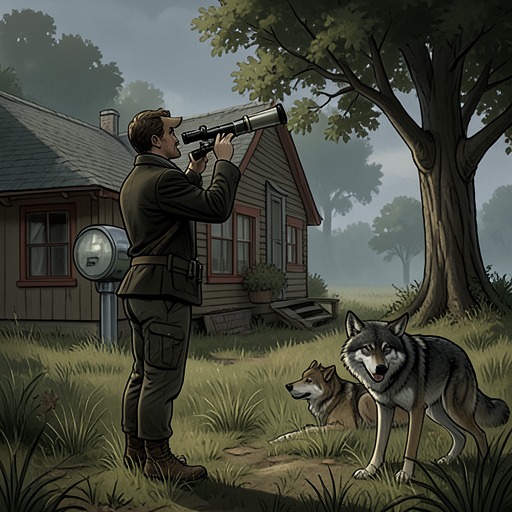
The distinction between hearing a sound and understanding it becomes vivid in Ootek’s first demonstration. While he and the narrator are watching the den on a calm day, Angeline and her pups are inside, escaping the flies, and the two males are sleeping after a long hunt. Ootek suddenly cups his hands to his ears and points toward hills about five miles to the north. The narrator hears nothing but mosquitoes. George, however, rises from the esker, directs his ears and muzzle north, and then gives a long, quavering howl. The same distant source that is inaudible to the human observer appears to have reached George, while Ootek claims to understand what it means.
That difference in access is not resolved by the scene. The narrator has no independent way to identify the sound Ootek says he has heard, and George’s answering howl alone cannot establish the message’s content. The episode instead sets out the problem that will shape the account: wolf communication may be audible to other wolves, and perhaps to a human listener with Ootek’s experience, without being available to an observer relying on ordinary hearing and interpretation.
Ootek as Listener and Interpreter
Ootek’s confidence is grounded in a relationship with wolves that predates the research camp. He tells the narrator that, when he was about five, his father—a respected shaman—took him to a wolf den and left him there for twenty-four hours. Ootek later recalled playing with the pups as an equal, while adult wolves sniffed him but did not harm him. He regarded wolves as actual relations, rather than as creatures defined by the misconceptions prevalent in the narrator’s society, and his personal helping spirit was Amarok, the Wolf Being.
The narrator learns that Ootek is himself a minor shaman only later. From the beginning, Ootek appears to regard the narrator’s scientific work as important, even though he may not understand its methods; he has inferred from Mike’s stories and the narrator’s conduct that the newcomer is a shaman of an unfamiliar kind. Ootek attaches himself to the observation work, bringing his sleeping robe to the tent, and the pair establish rudimentary communication through his few words of English, his perceptiveness, and Mike’s interpreting. His interest is therefore not simply a claim made for the narrator’s benefit: it belongs to a broader attention to wolves and to a distinctive body of experience.
The narrator nevertheless makes verification an explicit standard. He says that accepting every wolf-related account without supporting evidence would be unscientific, but finds Ootek invariably right when such evidence is obtainable. That judgment remains carefully bounded: it supports confidence in particular claims that can be checked, not automatic acceptance of everything Ootek says. The narrative’s method depends on preserving both sides of the encounter—Ootek’s expertise and the narrator’s own uncertainty.
Messages Across the Tundra
The first major test concerns caribou. Ootek interprets the distant wolf’s call as news that the animals have begun moving south and as an indication of where they are. In his account, the report has travelled through more than one territory: a wolf to the north is passing on information from a still more distant wolf, and George understands and relays it. The narrator finds this implausible. Mike, by contrast, packs for a hunting trip rather than waiting for proof at the camp.
Three days later Mike returns with venison and caribou tongues. He reports finding the caribou on the shore of Kooiak, roughly forty miles northeast of the cabin, exactly where Ootek had said they would be. The narrator initially attributes the match to coincidence, even while curiosity leads him to ask for further accounts. Mike maintains that wolves communicate over great distances and that some people, especially Ootek, can hear and understand enough to converse with them. The narrator remains skeptical, but asks Mike to have Ootek keep track of what the wolves say. The request marks a shift: uncertainty has not become belief, but it has become a reason to observe more closely.
A later episode concerns George and Uncle Albert’s absence from the den. Angeline repeatedly goes to the ridge to listen, while Ootek also attends to something beyond the narrator’s hearing. The narrator records the males’ return together at 12:17 p.m.; Ootek, who has been asleep in the tent and thus has not watched their arrival, later explains through Mike that George had told Angeline the hunting was poor and that he might not return until around midday. The timing fits Ootek’s interpretation, though the narrator notes that it is approximate. The episode adds a domestic dimension to the proposed messages: they may convey not only the location of prey but also information about a hunter’s absence and return.
Human News and the Evidence of Consequence
The communication claim is tested again when George turns his ears north on another afternoon but does not howl. Ootek becomes animated, repeats words the narrator understands as referring to people coming, and sets off across the tundra before the evening hunt begins. The narrator is left unsure what he has heard or why Ootek has gone. Later, Ootek returns with three shy friends. Mike confirms that Ootek had known they were on their way because, according to the explanation passed along, a wolf on the Five Mile Hills had reported their passage through its territory. Ootek had left the camp to meet them when the narrator failed to understand his warning.
The visitors’ arrival does not make the supposed message directly audible to the narrator, but it gives Ootek’s departure a concrete explanation. It also shows how the account’s evidence accumulates: a wolf is said to report human movement; Ootek interprets that report; his sudden journey is initially opaque; and the arrival of the visitors supplies a circumstance consistent with his interpretation. The narrator’s terse response to this confirmation conveys less a final scientific demonstration than the force of an event that fits the pattern he has been asked to consider.
Knowledge, Relationship, and Ecological Meaning
The communication episodes sit within a wider account of knowledge shared through relationships and practical experience. Ootek’s understanding of wolves also informs what he tells the narrator about their food and their close connection with caribou. He describes wolf and caribou as almost a single entity and conveys an origin story in which caribou are given as sustenance. The narrator presents the tale as Ootek’s account, mediated for him through Mike, rather than as a scientific observation; elsewhere, he tests Ootek’s claims against evidence when that is possible. The difference between story, interpretation, and observed confirmation remains part of the subject.
The same attention to situated knowledge matters in the human context. The narrator knows that Ottawa’s inquiry into the declining Keewatin caribou herd produced denials from trappers and traders, who blamed wolves while minimizing their own kills. Against that official pattern, Mike describes how trappers need caribou to feed working dogs and reports that they kill them when the animals are available. This evidence does not itself establish how wolves communicate, but it shows why information about caribou movements carries immediate practical importance for both people and wolves. Ootek’s interpretations are not detached curiosities: they connect animal movement, hunting, and the lives of the people travelling through the same landscape.
The concept therefore emerges through a productive tension between a trained observer’s demand for proof and an Indigenous interpreter’s knowledge of sounds that the observer cannot hear or translate unaided. Ootek is not reduced to a source of unexplained claims: his interpretations shape where Mike travels, explain his own actions, and repeatedly invite comparison with events. Nor does the narrator claim to have mastered wolf language. He records differences in hearing, moments of apparent accuracy, and the limits of what he can verify. Communication remains partly inaccessible, but it can no longer be dismissed as mere noise or assumed to be only a simple signal.